BBC Homepage
●Skip to content
●Accessibility Help
Your account
●Home
●News
●Sport
●Earth
●Reel
●Worklife
●Travel
●Culture
●Future
●Music
●TV
●Weather
●Sounds
●
Search BBC
●
●
●
●
●
●
●
●
●
●
●
●
●
Close menu
BBC News
Menu
●Home
●Israel-Gaza war
●War in Ukraine
●Climate
●Video
●World
●Asia
●UK
●Business
●Tech
More
●Science
●Entertainment & Arts
●Health
●World News TV
●In Pictures
●BBC Verify
●Newsbeat
●Tech
A glimpse at piracy in the UK and beyond
Published
Share page
About sharing
 Image caption,
Her fans love her - but are they all paying? Rihanna is one of the most heavily pirated artists in the world
ByDave Lee
Technology reporter, BBC News
For the first time, a detailed and fascinating look at the music downloading habits of a nation has been released.
The inaugural Digital Music Index, produced by monitoring service Musicmetric, has analysed huge swathes of illegal downloads.
Who is the most illegally shared artist in your area?
It logged the approximate locations of users obtaining music using BitTorrent - a method of getting files by downloading from many users at the same time.
The data suggests that Ed Sheeran - with his album + - is, so far this year, the most illegally downloaded artist in 459 of the 694 cities, towns and villages covered by the research.
Elsewhere, a diverse range of musical tastes can be found.
Such as the people on the Isle of Wight, whose most illegally download artist - based on monthly averages - is trumpet-playing crooner Louis Armstrong.
Meanwhile, in the Scottish Borders town of Galashiels, residents appear to have an arguably refined taste in music - their most popular artist is The Smiths.
More modern tastes were evident in the Oxfordshire village of Kidlington, who were said to be particularly fond of Justin Bieber over any other artist. So too in Great Yarmouth, a town that also has its fair share of "Beliebers".
Slow movers
By simply looking at the number of illegal downloads in each area, London predictably comes out on top.
In the first half of the year, over seven million files - mostly full albums - were downloaded illegally in the capital through peer-to-peer file sharing, says Musicmetric.
Second for volume was Birmingham (984,336 downloads per month) and then Glasgow (610,271 downloads).
But you get a more telling statistic when you take the population into account.
Per person, Musicmetric found Manchester to be the most prolific city for piracy - with Nottingham and Southampton coming second and third.
All of the top 10 towns and cities have a sizable student populations.
However, a strong student population does not necessarily lead to a large level of piracy. Loughborough - which has a very large student population - does not rank so highly, clocking up a monthly average of just over 3,000 illegal music downloads, the data indicates.
Unlike the most recent boat race, Oxford (8,511 downloads on average per month) and Cambridge (7,217 downloads) find themselves pretty close in the piracy stakes.
The data also suggests that quality of broadband plays at least some role in how active an area is with piracy.
Cardiff aside, piracy rates in Wales - where speeds are slower - are low, even in well-populated areas. In Llanelli, for instance, only 1,581 illegal downloads are logged each month.
But Yeovil, an area of similar population size with a faster average broadband speed, clocks up a monthly average of 4,259 downloads.
And the people of Carlisle, ranked one of the worst places in the country for broadband speed, rack up fewer than 2,000 pirated downloads per month - despite a population of over 70,000.
'Massive problem'
For the music industry, Musicmetric's report makes difficult reading.
The nature of illegal downloading makes it extremely difficult to track its full extent, but the study's findings are fully conclusive in at least one regard: piracy remains a massive issue.
Even at a time when the music industry is doing more than ever to offer more legal ways to download music - with stores like iTunes and streaming services such as Spotify - these efforts are apparently so far doing little to quell the internet community's desire to not pay for its music.
"It shows that illegal downloading remains a significant problem," Geoff Taylor, chief executive of UK music industry body the BPI told BBC News.
"It is having a significant effect on investment in new music. That remains our serious concern."
He argues that piracy continues to touch every inch of the industry.
"It's on session musicians who play in the studio; it's on the engineers and tape ops in the studio; it's on the guys working in a PR company trying to get coverage; it's on the marketing department; the guys in legal who are doing the contracts.
"We are losing hundreds of millions of pounds a year that should be getting invested into new music."
'I sell a lot of tickets'
Perhaps surprisingly, the BPI's annoyance does not appear to be shared by a person you'd perhaps expect to be concerned.
Speaking before the release of the report, Ed Sheeran told the BBC that he did not let piracy anger him.
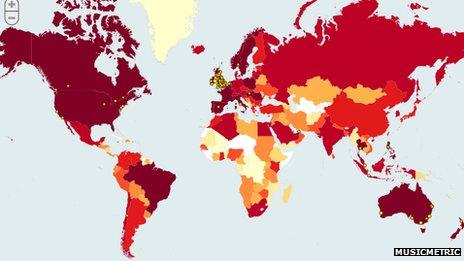 Image caption,
This map, produced by Musicmetric, shows the density of downloads of Ed Sheeran's music across the world
"I sell a lot of tickets," the songwriter said after his performance at Radio 1's Hackney Weekend.
"I've sold 1.2 million albums, and the stat is that there's 8 million downloads of that as well illegally.
"Nine million people have my record, in England, which is quite a nice feeling.
"I'm still selling albums, but I'm selling tickets at the same time. My gig tickets are like £18, and my albums £8, so ... it's all relative."
'Refreshing'
Mr Sheeran's comments are in line with those who say that the business model of the music industry is fundamentally changing.
A model which sees the album in a similar to way to how it sees the music video: as a promotional tool for the artist, a mechanism to sell live performance tickets.
"I think it's refreshing," says Peter Bradwell from the Open Rights Group, an organisation which campaigns against restrictions on the internet.
"There are artists basically doing experiments about how their music gets to people's ears and how people react to it.
"It's refreshing because it's somebody willing to think about whether these things are all bad or whether there are other ways of capitalising or not."
Until the industry is able to adapt to make the most from internet downloading, controversial measures will no doubt continue to be taken to stem the flow of illegal activity.
Earlier this year, the UK courts ordered internet service providers (ISPs) to block popular BitTorrent directory The Pirate Bay, to prevent UK users from visiting the site.
However, internet rights campaigners were quick to promote alternative ways to reach the site, such as proxy connections or alternative web addresses.
 Image caption,
The Pirate Bay claims to have more than 30m users worldwide
According to ISP data seen by the BBC, the ban on the Pirate Bay had little effect on the overall level of peer-to-peer illegal download traffic.
Mr Taylor, from the BPI, stands by the lengthy and expensive court action - and said more measures must be taken against other similar sites.
In the meantime, he said he wanted to appeal to the British sense of "fair play".
"We just need to get over to them the harm that they're doing to investment in new British music.
"If you love music, download legally because that's the only way we can keep on giving you great music."
Worldwide chart
Source: Musicmetric
Top stories
Live.
Lord Mandelson resigns from Labour to save party 'further embarrassment' over Epstein links
7312 viewing7.3k viewing
'Do you think you're the devil himself?' Epstein questioned in newly released interview
Published
12 hours ago
'Marry me' and £20,000 for rent - key Sarah Ferguson revelations in Epstein emails
Published
11 hours ago
More to explore
AI 'slop' is transforming social media - and a backlash is brewing
'ME and Long Covid have brought my children's lives to a standstill'

Watch: the must-see moments from the 2026 Grammy Awards

'Mandelson under fire' and 'Bring justice for Epstein victims'
Starbucks bets on robots to brew a turnaround in customers
How 'exercise snacking' can help you get fitter

Men covertly filming women at night and profiting from footage, BBC finds

Three West African juntas have turned to Russia. Now the US wants to engage them

Politics Essential: Get the latest news and analysis delivered to your inbox every weekday
Elsewhere on the BBC
Richard Burton and Clint Eastwood lead in this classic war film

Marie Curie, driven by curiosity, had to go into exile to work
Coming soon: Jack Thorne's adaptation of Lord of the Flies

Why do astronauts love shrimp cocktail so much?

Most read
1
'Marry me' and £20,000 for rent - key Sarah Ferguson revelations in Epstein emails
2
Men covertly filming women at night and profiting from footage, BBC finds
3
Bad Bunny makes Grammy history as stars protest against ICE
4
'Enemy' insults and questioning Putin: Steve Rosenberg on tightrope of reporting from Russia
5
AI 'slop' is transforming social media - and a backlash is brewing
6
The most eye-catching looks from the Grammy Awards, from Chappell Roan to Olivia Dean
7
All the winners at the 2026 Grammy Awards
8
Street where residents are terrified of flooding could be bulldozed
9
'Mandelson under fire' and 'Bring justice for Epstein victims'
10
Grammy highlights - from a chaotic Cher to Sabrina's stewardess
BBC News Services
●On your mobile
●On smart speakers
●Get news alerts
●Contact BBC News
●Home
●News
●Sport
●Earth
●Reel
●Worklife
●Travel
●Culture
●Future
●Music
●TV
●Weather
●Sounds
●Terms of Use
●About the BBC
●Privacy Policy
●Cookies
●Accessibility Help
●Parental Guidance
●Contact the BBC
●BBC emails for you
●Advertise with us
Copyright © 2026 BBC. The BBC is not responsible for the content of external sites. Read about our approach to external linking.
