Contents

See also

Tim BL Short biography
Address
Talks, articles etc
Speaking engagements
Press interviews
Longer Biography
Research at MIT-CSAIL
Design Issues: web architecture
World Wide Web Consortium Frequently Asked Questions
Kids' Questions
2025 book: This is for Everyone

datadatadata

Tim Berners-Lee

Biography


Sir Tim Berners-Lee invented the World Wide Web  while at CERN, the European  Particle Physics Laboratory, in 1989. He wrote the first web  client and server in 1990. His specifications of URIs, HTTP and  HTML were refined as Web technology spread.

He is the co-founder and CTO of Inrupt.com, a tech start-up that uses,  promotes and helps develop the open source Solid platform. Solid aims to give  people control and agency over their data, questioning many  assumptions about how the web has to work. Solid technically is a new level  of standard at the web layer, which adds features  never put into the original spec, such as global single sign-on,  universal access control, and a universal data API so that any  app can store data in any storage place. Socially Solid is a  movement away from much of the issues with the current WWW, and  toward a world in which users are in control, and empowered by  large amounts of data, private, shared, and public.

Sir Tim is the Founder, Emeritus Director, and an Honorary Member of the Board of Directors of the  World Wide Web Consortium (W3C), a Web standards  organization that he founded in 1994 which develops interoperable  technologies (specifications, guidelines, software, and tools) to  lead the Web to its full potential. He is a Director of the  World Wide Web  Foundation that was launched in 2009 to coordinate efforts  to further the potential of the Web to benefit humanity.

He is the Emeritus 3Com Founders Professor of Engineering in the School  of Engineering with a joint appointment in the Department of  Electrical Engineering and Computer Science at the Laboratory for  Computer Science and Artificial Intelligence ( CSAIL) at the Massachusetts Institute  of Technology (MIT) where he  founded the Decentralized  Information Group (DIG).

Research at DIG and its collaborators was the origin of what became the Solid Platform.  
He is also a Professor in the  Computer Science Department,  and an Honorary Student at  Christ Church, at the University of Oxford, UK.   He is President of and co-founder the Open Data Institute in London.

In 2001 he became a Fellow of the Royal Society. He has been  the recipient of several international awards including the Japan  Prize, the Prince of Asturias Foundation Prize, the Millennium  Technology Prize and Germany's Die Quadriga award. In 2004 he was  knighted by H.M. Queen Elizabeth and in 2007 he was awarded the  Order of Merit. In 2009 he was elected a foreign associate of the  National Academy of Sciences. He is the author of "Weaving the Web".

On March 18 2013, Sir Tim, along with Vinton Cerf, Robert  Kahn, Louis Pouzin and Marc Andreesen, was awarded the Queen Elizabeth Prize for Engineering  for "ground-breaking innovation in engineering that has been of  global benefit to humanity."

On 4 April 2017, Sir Tim was awarded the ACM A.M. Turing Prize for inventing the World  Wide Web, the first web browser, and the fundamental protocols  and algorithms allowing the Web to scale. The Turing Prize,  called the "Nobel Prize of Computing" is considered one of the  most prestigious awards in Computer Science. 
In September 2022, he won the Seoul Peace Prize for his work promoting data sovereignty and leading the movement to decentralize the web dominated by tech giants.

In September 2025, Sir Tim released his new book: This is for Everyone.
 
(Longer biography)
 

Contact


Email:

Chief of Staff cos@timbl.com
 
Address

W3C/MIT/CSAIL

32 Vassar Street
 Cambridge MA 02139
 USA

Other platforms

User Timbl on Wikipedia,  ORCID,  DBLP,  OpenReview,  Github  

Talks, articles, interviews,  etc


My blog on technology and society is called DesignIssues.

Videos


"The World Wide  Web - A Mid-Course Correction," The Richard Dimbleby  Lecture, November 2019

A Magna Carta for the Web, TED talk,  2014

The Year Open Data Went Worldwide,  TED talk, 2010

The Next Web, TED talk, 2009
 

Essays and articles in text form


We Need to Change How We Share Our Personal Data Online in the  Age of COVID-19, Time magazine, 15 July 2020

Tim Berners-Lee thinks the world can be better after  Covid-19, Quartz, 30 June 2020

Covid-19 makes it clearer than ever: access to the internet  should be a universal right, The Guardian, 4 June  2020

Why the  web needs to work for women and girls, The World Wide Web  Foundation, 2020

I Invented the World Wide Web. Heres How We Can Fix It,  OpEd, New York Times, 24 November 2019

Where Does the World Wide Web Go From Here?, Wired, 3  November 2019

30 years  on, whats next #ForTheWeb?, The World Wide Web Foundation,  2019

One Small  Step for the Web, Inrupt, November 2018

The web is  under threat. Join us and fight for it, The World Wide Web  Foundation, 2018

Three  challenges for the web, according to its inventor, The  World Wide Web Foundation, 2017

The many meanings of Open, Telefonica, 2013

"Tim  Berners-Lee on the Web at 25: the past, present and  future, Wired, 23 August 2014

Long Live the Web: A Call for Continued Open Standards and  Neutrality Scientific American Noverber 2010

"Linked Data"  (slides) at the TED 2009 conference,  "The Great Unveiling" in Long Beach, CA, USA, 4 February  2009.

The Future of the Web. Testimony before the United  States House of Representatives Committee on Energy and  Commerce Subcommittee on Telecommunications and the Internet.  (2007-03-01)

The  Mobile Web Keynote, 3GSM Barcelona, (2007-02-22)

Speech  and the Future Keynote, SpeechTek New York,  (2004-09-14)

Comment on the '906  patent (2003)

Japan Prize  commemorative lecture on the universality of the Web  (2002)

Michael Dertouzos R.I.P.  (2001-08-27)

D.M.Sendall. R.I.P. July 15  1999

The future of the Web -  LCS 35th anniversary talk transcript

WWW, UU and I - Unitarian Universalism  and the Web (1998/4)

A one-page personal history of  the web (1998/5/7)

Realizing the full  potential of the web (1997/12/3)

World-Wide Computer Communications of the ACM,  February 1997, Vol. 40 No 2.

The web: Past, Present and Future  (1996)

The Web; Europe and the US;  Harmony and Diversity (1996)

Hypertext and Our  Collective Destiny , (1995)

Presentation to CDA challenge by  CDT et al , 28 Feb 1996

Original  proposal for a global hypertext project at CERN (1989)
 

Interviews:


Rethinking Digital  Access, BBC "Rethink" podcast, 24 June 2020

World wide web founder scales up efforts to reshape  internet, Forbes, 22 February 2020 

The  World Wide Web Turns 30 Today. Here's How Its Inventor Thinks  We Can Fix It, Time Magazine, 12 March 2019

I was devastated: Tim Berners-Lee, the man who created the  world wide web, has some regrets, Vanity Fair, 1 July  2018

"The Webs Creator Looks to Reinvent It, New York Times, 7  June 2016

"Putting data back into the hands of owners, TechCrunch,  20 December 2016
 

If you want to know what we are working on now, look at the  W3C site and check  out all the activities at W3C. Also see:


Design  Issues: Technical and philosophical notes on web  architecture An occasional series of notes about how the  web actually works and how to design new technology.

For a list of past talks, see: Presentations via the W3C Presentations system or an extensive  list in HTML.

Disclosures

History of the  web: some pointers
 

Speaking  Engagements


I do a limited amount of speaking. If you have something you  think I would be interested in speaking at, for academic events  email timbl+speaking@w3.org with  details of the event, projected audience size and profile,  location and date.

My professional speaking is handled by Jana Padula at the  Harry Walker Agency, (janap@harrywalker.com)  (you may also  cc Don Walker donw@harrywalker.com and please  cc me as above).

Please use an email subject line with relevant information  such as: : "Keynote in Milan, 23 Febrary 2100 at ISWC2100"  including the date and place proposed.

AV Requirements


If I use slides (I often do not) I use a laptop -- currently a  Mac running OSX. I do not need audio from the laptop.

Press: requesting interviews and  materials


If you need a photo for publication, please complete the  W3C photo request form. You  do not need an account to complete the form, but an email address  is required.

Alternatively, you can ask:


(for information on the beginning of the Web prior to 1994)  The press office at CERN (+41  22 767 6111)

W3C's Communications  Team
 

If you need an interview for an article, please check  the


W3C FAQ

my FAQ
 

first, then please use email rather than phone. Please contact  my Chief of Staff (cos@timbl.com).

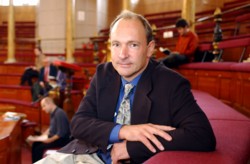
[Photo: in Sheldonian, Oxford: LeFevre communications,  2001.] 

Accessibility at MIT and at  W3C  


$Id$  for timbl