 ●News
●News
●News
●News
![[RSS]](/static/img/feed-icon-14x14.2168a573d0d4.png) Conservancy Blog
Conservancy Blog
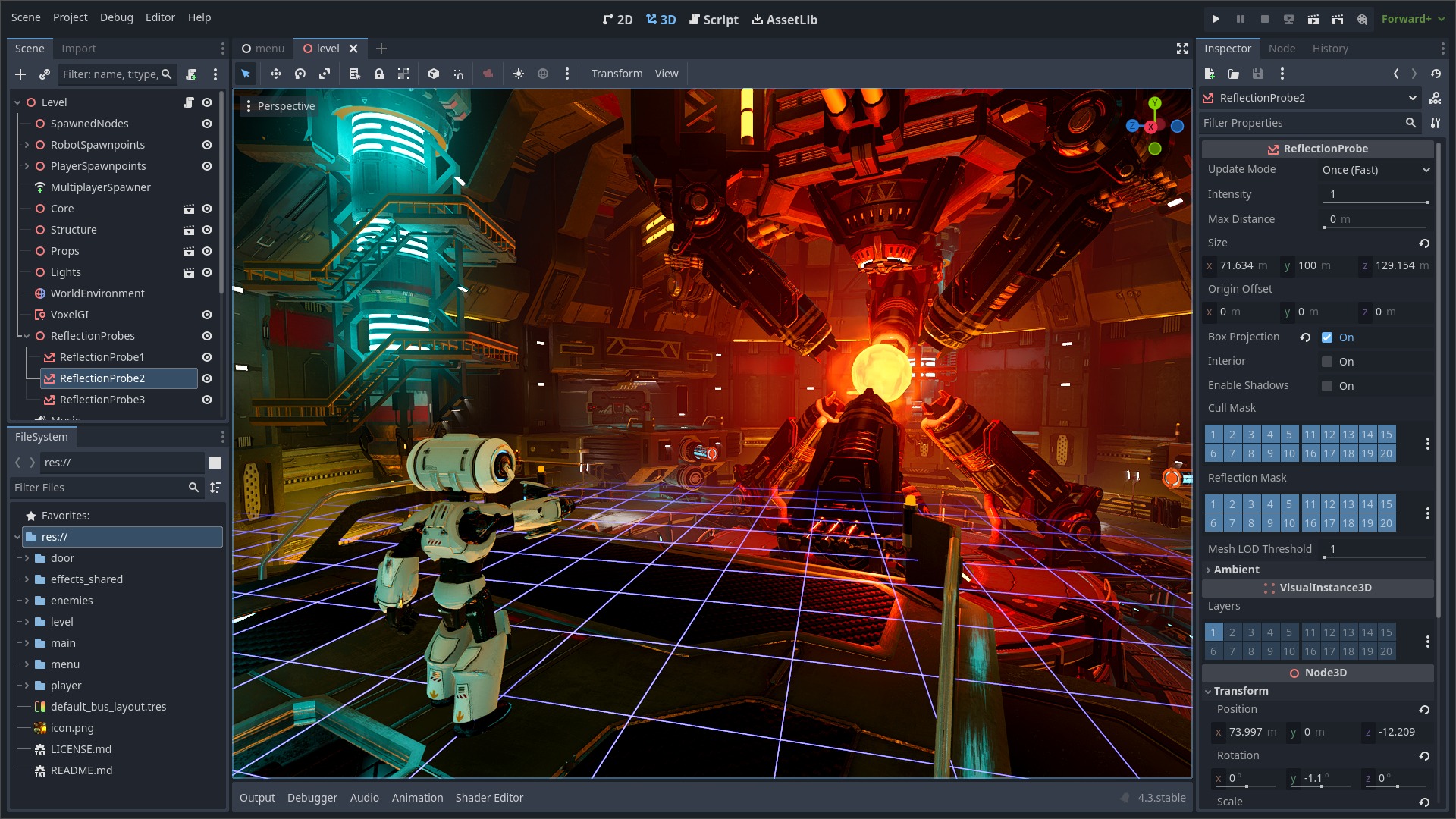 Godot demo screenshot, licensed CC BY-SA 4.0
Godot has been a Conservancy member project since 2015. Vladimir Bejdo, a Conservancy intern, conducted a remote interview with Juan Linietsky, the engine's Lead Developer, for a quick update on the work Godot is doing now five years after it joined the Conservancy and to gain some insights on the project's future.
JL: Juan Linietsky; VB: Vladimir Bejdo
VB: Juan, tell me a bit about how you got into free software to begin with – was there a particular moment
or experience you could relate back to which makes free software important to you and informed
this project’s libre status?
JL: I used Linux for programming since around 1997, so I was always very comfortable with free software tools. I also wrote some music composing hardware many years ago and licensed it as free software.
Initially, as Godot was not meant be a commercialized product, it was put online as open source with the hopes that others would contribute.
VB: Tell me a bit about the history of the Godot Engine – what drove its creation? Why make it free
software?
JL: Godot was my (and Ariel Manzur's) in-house game engine for a long time. We used it to create technology for a diverse amount of clients in the past.
This was done at a time where game engines were not accessible and one needed to create the technology on your own. Because it was never meant to be a product, we open sourced it.
VB: Godot aims to provide an open, accessible, permissively licensed game engine – it would be easy
to say that for many end-users and emerging developers, games are often a point of first contact
with software – what kind of work does the project do to make what can often be people’s first
introduction to development work accessible, and how does free software philosophy work into
those aims?
JL: Godot development priorities are always very user oriented. Taking feedback from users is more important than just adding features for the sake of it.
When we see users have issues with something, we try to work around it to ensure a better experience.
VB: Developing something like a game engine is somewhat of a herculean task – how has
peer/community production contributed to the project’s success so far? How does the project
converge with other free software projects in existence?
JL: Coexistence with other free software projects is a bit difficult. Godot does mostly not make heavy use of other open source software as a base, and instead we write our own versions of things.
This is because generally we have very precise needs to solve; it's easier to roll out our own solution than doing politics with other projects to see how to work together. So, unless a library we use is exactly what we need, we tend to roll out our own.
Things may take longer, but Godot becomes a lot more consistent as a result.
VB: What do you see for the future of your project as a whole?
JL: To be honest I have no idea, we are constantly running behind because it's growing so fast. I am really hoping for a time where we can work more on stabilizing the codebase and fully focusing on user experience.
VB: Would you be willing to share any use-cases of games created in Godot?
JL: Feel free to take a look at our showreel. We have lots of very beautiful looking games.
VB: Speaking more generally – what do you see for the future of free and open source software as a
whole?
JL: I have mixed experiences as an open source software user myself. I am of the thinking that user experience is important when you write software, and that you should listen to your users in order to improve what you are doing. In my opinion, the biggest flaw open source software has is when the authors believe they know better than their users or other potential contributors. This hampers their ability to grow as a community. I really hope this eventually changes in the future in open source software.
VB: The Godot Engine has been a Conservancy member project for a few years now – what has
changed since the Engine joined the Conservancy? How has Godot – as a project, and its
community – grown over the past few years?
JL: The success of Godot as a project would have been impossible without Conservancy. The work they do to support projects in a way where they can receive donations and the way they are transparent and ensure that all funding is used for the benefit of the project is key to gaining trust with users, contributors, patrons and sponsors. It would be impossible for the project to finance itself without their help.
VB: Any closing remarks? Say someone reading this review were interested in getting involved with
Godot – besides supporting the Conservancy, how might they do that?
JL: Besides thanking Conservancy again for all their help and support, I would love to invite anyone interested in taking part of the development to read our documentation page about ways to contribute.
Software Freedom Conservancy is in the middle of its annual fundraiser. Please help us continue our work by becoming a Supporter. Donate now and have your donation matched by a group of generous individuals who care deeply about software freedom.
[permalink]
Tags:
Godot
Godot demo screenshot, licensed CC BY-SA 4.0
Godot has been a Conservancy member project since 2015. Vladimir Bejdo, a Conservancy intern, conducted a remote interview with Juan Linietsky, the engine's Lead Developer, for a quick update on the work Godot is doing now five years after it joined the Conservancy and to gain some insights on the project's future.
JL: Juan Linietsky; VB: Vladimir Bejdo
VB: Juan, tell me a bit about how you got into free software to begin with – was there a particular moment
or experience you could relate back to which makes free software important to you and informed
this project’s libre status?
JL: I used Linux for programming since around 1997, so I was always very comfortable with free software tools. I also wrote some music composing hardware many years ago and licensed it as free software.
Initially, as Godot was not meant be a commercialized product, it was put online as open source with the hopes that others would contribute.
VB: Tell me a bit about the history of the Godot Engine – what drove its creation? Why make it free
software?
JL: Godot was my (and Ariel Manzur's) in-house game engine for a long time. We used it to create technology for a diverse amount of clients in the past.
This was done at a time where game engines were not accessible and one needed to create the technology on your own. Because it was never meant to be a product, we open sourced it.
VB: Godot aims to provide an open, accessible, permissively licensed game engine – it would be easy
to say that for many end-users and emerging developers, games are often a point of first contact
with software – what kind of work does the project do to make what can often be people’s first
introduction to development work accessible, and how does free software philosophy work into
those aims?
JL: Godot development priorities are always very user oriented. Taking feedback from users is more important than just adding features for the sake of it.
When we see users have issues with something, we try to work around it to ensure a better experience.
VB: Developing something like a game engine is somewhat of a herculean task – how has
peer/community production contributed to the project’s success so far? How does the project
converge with other free software projects in existence?
JL: Coexistence with other free software projects is a bit difficult. Godot does mostly not make heavy use of other open source software as a base, and instead we write our own versions of things.
This is because generally we have very precise needs to solve; it's easier to roll out our own solution than doing politics with other projects to see how to work together. So, unless a library we use is exactly what we need, we tend to roll out our own.
Things may take longer, but Godot becomes a lot more consistent as a result.
VB: What do you see for the future of your project as a whole?
JL: To be honest I have no idea, we are constantly running behind because it's growing so fast. I am really hoping for a time where we can work more on stabilizing the codebase and fully focusing on user experience.
VB: Would you be willing to share any use-cases of games created in Godot?
JL: Feel free to take a look at our showreel. We have lots of very beautiful looking games.
VB: Speaking more generally – what do you see for the future of free and open source software as a
whole?
JL: I have mixed experiences as an open source software user myself. I am of the thinking that user experience is important when you write software, and that you should listen to your users in order to improve what you are doing. In my opinion, the biggest flaw open source software has is when the authors believe they know better than their users or other potential contributors. This hampers their ability to grow as a community. I really hope this eventually changes in the future in open source software.
VB: The Godot Engine has been a Conservancy member project for a few years now – what has
changed since the Engine joined the Conservancy? How has Godot – as a project, and its
community – grown over the past few years?
JL: The success of Godot as a project would have been impossible without Conservancy. The work they do to support projects in a way where they can receive donations and the way they are transparent and ensure that all funding is used for the benefit of the project is key to gaining trust with users, contributors, patrons and sponsors. It would be impossible for the project to finance itself without their help.
VB: Any closing remarks? Say someone reading this review were interested in getting involved with
Godot – besides supporting the Conservancy, how might they do that?
JL: Besides thanking Conservancy again for all their help and support, I would love to invite anyone interested in taking part of the development to read our documentation page about ways to contribute.
Software Freedom Conservancy is in the middle of its annual fundraiser. Please help us continue our work by becoming a Supporter. Donate now and have your donation matched by a group of generous individuals who care deeply about software freedom.
[permalink]
Tags:
Godot
 Photo is by Deb Nicholson and is available under a CC-BY-SA-4.0 license
We ran the Second Annual Copyleft Conf on Monday. The event sparked lively and respectful conversations about the use and future of copyleft. The event included an exciting, multi-faceted schedule of talks and panels. Our lovely program committee — Molly de Blanc, Nithya Ruff, Harald Welte, Josh Simmons, Beth Flanagan, Bradley Kuhn and Deb Nicholson — curated and selected excellent content for the day. Thanks also to our Copyleft Conf volunteers, who helped with registration, speaker introductions and time-keeping.
All the Copyleft Conf sessions and Deb's CHAOSS Con keynote (a Friday “FOSDEM Fringe” event), Ethics: What You Know & What You Don't Know should be posted within a few weeks.
[permalink]
Tags:
conferences,
Godot,
Outreachy
●Main Page
●Contact
●Sponsors
●RSS Feed
●Donate
Software Freedom Conservancy is a 501(c)(3) non-profit charity.
Privacy Policy last updated 22 December 2020.
This page and its contents are licensed under a Creative Commons Attribution-Share Alike 4.0 International License.
Photo is by Deb Nicholson and is available under a CC-BY-SA-4.0 license
We ran the Second Annual Copyleft Conf on Monday. The event sparked lively and respectful conversations about the use and future of copyleft. The event included an exciting, multi-faceted schedule of talks and panels. Our lovely program committee — Molly de Blanc, Nithya Ruff, Harald Welte, Josh Simmons, Beth Flanagan, Bradley Kuhn and Deb Nicholson — curated and selected excellent content for the day. Thanks also to our Copyleft Conf volunteers, who helped with registration, speaker introductions and time-keeping.
All the Copyleft Conf sessions and Deb's CHAOSS Con keynote (a Friday “FOSDEM Fringe” event), Ethics: What You Know & What You Don't Know should be posted within a few weeks.
[permalink]
Tags:
conferences,
Godot,
Outreachy
●Main Page
●Contact
●Sponsors
●RSS Feed
●Donate
Software Freedom Conservancy is a 501(c)(3) non-profit charity.
Privacy Policy last updated 22 December 2020.
This page and its contents are licensed under a Creative Commons Attribution-Share Alike 4.0 International License.
