Skip to main content  


About
Contact

Press

People

Opportunities

EFF's 35th Anniversary


Issues
Free Speech

Privacy

Creativity and Innovation

Transparency

International

Security


Our Work
Deeplinks Blog

Press Releases

Events

Legal Cases

Whitepapers

Podcast

Annual Reports


Take Action
Action Center

Electronic Frontier Alliance

Volunteer


Tools
Privacy Badger

Surveillance Self-Defense

Certbot

Atlas of Surveillance

Cover Your Tracks

Street Level Surveillance

apkeep


Donate
Donate to EFF

Giving Societies

Shop

Sponsorships

Other Ways to Give

Membership FAQ


Donate
Donate to EFF

Shop

Other Ways to Give


Email updates on news, actions,
 and events in your area.  

Join EFF Lists  


Copyright (CC BY)

Trademark

Privacy Policy

Thanks


Electronic Frontier Foundation 


Donate  


Electronic Frontier Foundation 


About
Contact

Press

People

Opportunities

EFF's 35th Anniversary


Issues
Free Speech

Privacy

Creativity and Innovation

Transparency

International

Security


Our Work
Deeplinks Blog

Press Releases

Events

Legal Cases

Whitepapers

Podcast

Annual Reports


Take Action
Action Center

Electronic Frontier Alliance

Volunteer


Tools
Privacy Badger

Surveillance Self-Defense

Certbot

Atlas of Surveillance

Cover Your Tracks

Street Level Surveillance

apkeep


Donate
Donate to EFF

Giving Societies

Shop

Sponsorships

Other Ways to Give

Membership FAQ


Donate
Donate to EFF

Shop

Other Ways to Give


Content Blocking


Free Speech banner, an colorful graphic representation of a megaphone


Content Blocking


Governments around the world block access to online content for a variety of reasons: to shield children from obscene content, to prevent access to copyright-infringing material or confusingly named domains, or to protect national security. From democratic nations such as India, the United Kingdom, and South Korea to states with authoritarian governments, states are implementing extensive filtering regimes with varying degrees of transparency and consistency.

EFF believes that the blocking and filtering by nation states of the global Internet is a violation of Article 19 of the Universal Declaration of Human Rights, which grants everyone the right "to seek, receive and impart information and ideas through any media and regardless of frontiers." Since our founding in 1990, we have fought to preserve the capacity of the Internet to allow everyone to speak without hindrance, and for everyone to freely choose who they communicate with, no matter whoor wherethey may be.

How Countries Block Content


There are various methods used to block content online. Government actors can block or tamper with domain names, filter and block specific keywords, block a particular IP address, or urge online content providers to remove content or search results. Often, governments rely upon commercial software to do the job for them. Products readily available on the market for use in homes, schools, and libraries have been used in several countries. Though the export and sale of these tools is generally legal, it often raises questions of human rights and corporate social responsibility. Some countries, such as China, use a combination of the aforementioned techniques, by pervasively blocking keywords, foreign websites, and urging companies such as Google to remove certain content. Others, such as Morocco and Egypt, take a minimalist approach to content blocking, by filtering a certain selection of URLs. The level of transparency in content blocking also differs from country to country. Some offer block pages that explain to users that a site is blocked (as well as, sometimes, why it is blocked) and/or means of challenging a specific site block, while others re-direct the user to an error page; before the fall of the Ben Ali regime, for example, Tunisia famously redirected users to an HTTP 404 error page.

Why Countries Block Content


Countries block online content for a variety of reasons, often based on national cultural norms or political considerations. India for example, uses the pretext of public safety to enact laws allowing certain websites to be blocked, while other countries, such as Qatar, primarily block websites for containing pornography or other content that they claim offends the sensibilities of their citizens. Russia blocks child pornography, as well as online content containing materials advocating drug abuse, suicide, or  extremism. Still others block websites or domains under the pretense of preventing copyright or trademark infringement. An increasing number of governments also block websites belonging to their political opposition, human rights organizations, and independent media.

What EFF is Doing


Whenever possible, EFF engages with policymakers to ensure that the Internet remains an open platform for free expression. We also support the efforts of organizations like Tor to empower Internet users residing in censored countries to protect their identities, circumvent firewalls, and access blocked content. Content blocking occurs in both autocratic and democratic countries. EFF seeks to amplify the voices of local grassroots organizations opposing censorship all over the world, and educate our members about those groups  concerns. We frequently join international campaigns against censorship, and provide updates on content blocking and other censorship incidents on the Deeplinks blog.


Protect digital privacy and free expression. EFF's public interest legal work, activism, and software development preserve fundamental rights.
Protect digital privacy and free expression. EFF's public interest legal work, activism, and software development preserve fundamental rights. DONATE TO EFF



EFF Related Content: Content Blocking


A multi-colored bullhorn icon surrounded by grey-blue hexagons Deeplinks Blog byPaige Collings  | January 20, 2026

EFF Joins Internet Advocates Calling on the Iranian Government to Restore Full Internet Connectivity


EFF has joined architects, operators, and stewards of the global internet infrastructure in calling upon authorities in Iran to immediately restore full and unfiltered internet access. We further call upon the international technical community to remain vigilant in monitoring connectivity and to support efforts that ensure the internet remains open...


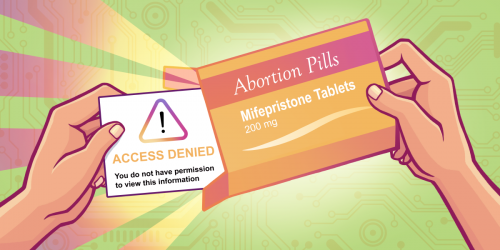
Illustration of hands opening abortion pills box and pulling out a insert that says "Access Denied" Deeplinks Blog byJennifer Pinsof  | April 28, 2025

Texass War on Abortion Is Now a War on Free Speech


UPDATE May 8, 2025: A committee substitute of SB 2880 passed the Texas Senate on April 30, 2025, with the provisions related to interactive computer services and providing information on how to obtain an abortion-inducing drug removed. These provisions, however, currently remain in the House version...


illustration of hands opening box of abortion pills, pulling out insert that says "Access Denied" Press Release  | February 19, 2025

EFF and Repro Uncensored Launch #StopCensoringAbortion Campaign 


SAN FRANCISCOThe Electronic Frontier Foundation (EFF) and the Repro Uncensored coalition on Wednesday launched the #StopCensoringAbortion campaign to ensure that people who need reproductive health and abortion information can find and share it. Censorship of this information by social media companies appears...


Hands opening a box of abortion pills and pulling out a insert that says "Access Denied" Deeplinks Blog byRindala Alajaji  | February 19, 2025

Stop Censoring Abortion: The Fight for Reproductive Rights in the Digital Age


We are collecting stories from individuals and organizations who have faced censorship on social media platforms to expose the true scale of abortion censorship. Our goal is to demand greater transparency in tech companies' moderation practices and ensure that their actions do not silence critical conversations about reproductive rights.


brazil fake news bill Deeplinks Blog byCorynne McSherry  | October 8, 2024

The X Corp. Shutdown in Brazil: What We Can Learn


The feud between X Corp. and Brazils Supreme Court continues to drag on.


Pages

1

2

3

4

5

6

7

8

9


next 

last »


Back to top


EFF Home

Follow EFF:


mastodon

facebook

instagram

x

Blue Sky

youtube

flicker

linkedin

tiktok

threads


Check out our 4-star rating on Charity Navigator.
 

Contact


General

Legal

Security

Membership

Press


About


Calendar

Volunteer

Victories

History

Internships

Jobs

Staff

Diversity & Inclusion


Issues


Free Speech

Privacy

Creativity & Innovation

Transparency

International

Security


Updates


Blog

Press Releases

Events

Legal Cases

Whitepapers

EFFector Newsletter


Press


Press Contact


Donate


Join or Renew Membership Online

One-Time Donation Online

Giving Societies

Corporate Giving and Sponsorship

Shop

Other Ways to Give


Copyright (CC BY)

Trademark

Privacy Policy

Thanks


JavaScript license information