Skip to main content  


About
Contact

Press

People

Opportunities

EFF's 35th Anniversary


Issues
Free Speech

Privacy

Creativity and Innovation

Transparency

International

Security


Our Work
Deeplinks Blog

Press Releases

Events

Legal Cases

Whitepapers

Podcast

Annual Reports


Take Action
Action Center

Electronic Frontier Alliance

Volunteer


Tools
Privacy Badger

Surveillance Self-Defense

Certbot

Atlas of Surveillance

Cover Your Tracks

Street Level Surveillance

apkeep


Donate
Donate to EFF

Giving Societies

Shop

Sponsorships

Other Ways to Give

Membership FAQ


Donate
Donate to EFF

Shop

Other Ways to Give


Email updates on news, actions,
 and events in your area.  

Join EFF Lists  


Copyright (CC BY)

Trademark

Privacy Policy

Thanks


Electronic Frontier Foundation 


Donate  


Electronic Frontier Foundation 


About
Contact

Press

People

Opportunities

EFF's 35th Anniversary


Issues
Free Speech

Privacy

Creativity and Innovation

Transparency

International

Security


Our Work
Deeplinks Blog

Press Releases

Events

Legal Cases

Whitepapers

Podcast

Annual Reports


Take Action
Action Center

Electronic Frontier Alliance

Volunteer


Tools
Privacy Badger

Surveillance Self-Defense

Certbot

Atlas of Surveillance

Cover Your Tracks

Street Level Surveillance

apkeep


Donate
Donate to EFF

Giving Societies

Shop

Sponsorships

Other Ways to Give

Membership FAQ


Donate
Donate to EFF

Shop

Other Ways to Give


National Security Letters


National Security Letters


FAQ

Timeline


National Security Letters


Since the first national security letter (NSL) statute was passed in 1986 and then dramatically expanded under the USA PATRIOT Act, the FBI has issued hundreds of thousands of such letters seeking the private telecommunications and financial records of Americans without any prior approval from courts. In addition to this immense investigatory power, NSL statutes also permit the FBI to unilaterally gag recipients and prevent them from criticizing such actions publicly. This combination of powers  to investigate and to silence  has coalesced to permit the FBI to wield enormous power and to operate without meaningful checks, far from the watchful eyes of the judicial branch. Not surprisingly, this lack of checks has contributed to a dramatic expansion in the use of these tools across the country. Indeed, for the period between 2003 and 2006 alone, almost 200,000 requests for private customer information were sought pursuant to various NSL statutes.

EFF has fought for years to spread awareness of National Security Letters and add accountability and oversight to the process. Beginning in 2011, we brought a set of major constitutional challenges to the NSL statute on behalf of the NSL recipients CREDO and Cloudflare, who were forced to litigate in secret for almost six years. In 2013, we won a landmark victory in the Northern District of California in which Judge Susan Illston declared one of the statutes unconstitutional in one of CREDO's cases.

In response, Congress amended the NSL statute as part of the USA FREEDOM Act in June 2015. In July 2017, the U.S. Court of Appeals for the Ninth Circuit issued an opinion upholding the amended NSL statute against these providers' challenges.

EFF continues to push for NSL reform, including by asking companies to require judicial review of all NSLs. We are also pursuing a FOIA lawsuit for more information about the NSL "Termination Procedures" adopted pursuant to USA Freedom.. This builds on over a decade of FOIA work and other advocacy regarding NSLs. For example, in 2007 EFF filed Freedom of Information Act litigation seeking documentation of National Security Letter misuse by the FBI. Thousands of pages of documents were released over a period of four years leading to repeated revealationsofgovernment abuses of power. An EFF report based on these documents led to tough questions for the FBI before Congress. The documents also helped prompt the Senate Judiciary Committee to investigate whether Attorney General Alberto Gonzales lied to Congress. And in 2008 and again in 2016, EFF successfully defended the Internet Archive from inappropriate National Security Letters. 


Protect digital privacy and free expression. EFF's public interest legal work, activism, and software development preserve fundamental rights.
Protect digital privacy and free expression. EFF's public interest legal work, activism, and software development preserve fundamental rights. DONATE TO EFF


EFF Related Content: National Security Letters


Press Release  | November 1, 2023

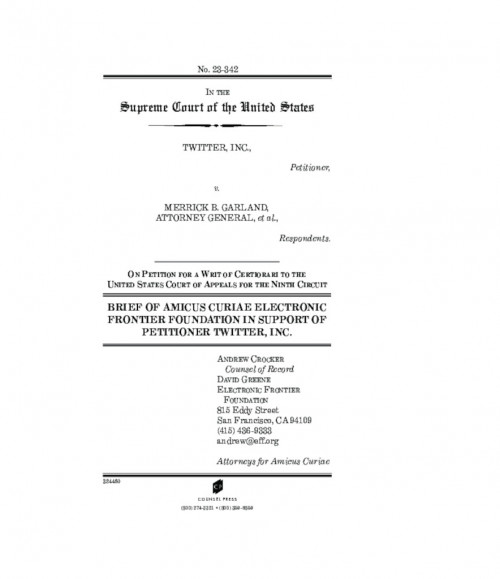
EFF to Supreme Court: Reverse Dangerous Prior Restraint Ruling Upholding FBI Gag on Xs Surveillance Transparency Report


WASHINGTON, D.C.The Electronic Frontier Foundation (EFF) urged the Supreme Court today to review and reverse a dangerous ruling allowing the Justice Department to censor Xs ability to publish information about government requests for the platforms private user data, a decision that undermines at least a hundred years of...


Document  | November 1, 2023

EFF Brief Twitter vs Garland


Deeplinks Blog byAndrew Crocker  | March 10, 2023

Appeals Court Upholds Restriction on Twitters First Amendment Right to Publish National Security Transparency Report


Español

A ruling from the Ninth Circuit Court of Appeals earlier this week marks a new low in judicial deference to classification and national security, even against the nearly inviolable First Amendment right to be free of prior restraints against speech. In Twitter v. Garland, the court ruled that it...


Document  | September 30, 2020

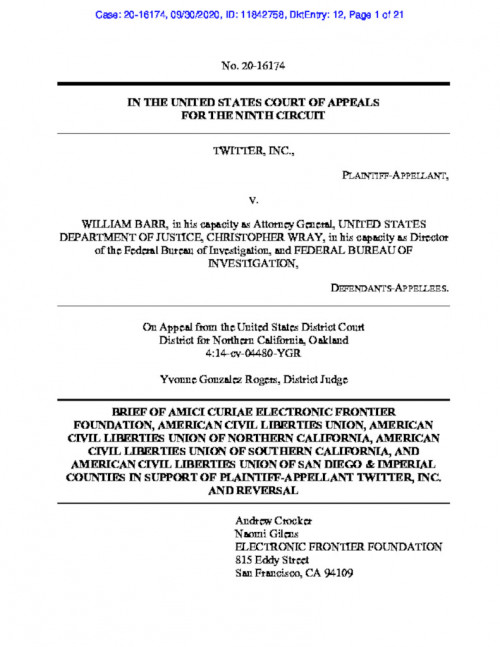
Twitter v. Barr: amicus brief of EFF & ACLU


Twitter bird tweeting Deeplinks Blog  by Naomi Gilens  | October 9, 2020

EFF and ACLU Ask Ninth Circuit to Overturn Governments Censorship of Twitters Transparency Report 


Citing national security concerns, the government is attempting to infringe on Twitter's First Amendment right to inform the public about secret government surveillance orders. For more than six years, Twitter has been fighting in court to share information about law enforcement orders it received in 2014. Now, Twitter has brought...


Pages

1

2

3

4

5

6

7

8

9


next 

last »


Back to top


EFF Home

Follow EFF:


mastodon

facebook

instagram

x

Blue Sky

youtube

flicker

linkedin

tiktok

threads


Check out our 4-star rating on Charity Navigator.
 

Contact


General

Legal

Security

Membership

Press


About


Calendar

Volunteer

Victories

History

Internships

Jobs

Staff

Diversity & Inclusion


Issues


Free Speech

Privacy

Creativity & Innovation

Transparency

International

Security


Updates


Blog

Press Releases

Events

Legal Cases

Whitepapers

EFFector Newsletter


Press


Press Contact


Donate


Join or Renew Membership Online

One-Time Donation Online

Giving Societies

Corporate Giving and Sponsorship

Shop

Other Ways to Give


Copyright (CC BY)

Trademark

Privacy Policy

Thanks


JavaScript license information