Skip to main content  


About
Contact

Press

People

Opportunities

EFF's 35th Anniversary


Issues
Free Speech

Privacy

Creativity and Innovation

Transparency

International

Security


Our Work
Deeplinks Blog

Press Releases

Events

Legal Cases

Whitepapers

Podcast

Annual Reports


Take Action
Action Center

Electronic Frontier Alliance

Volunteer


Tools
Privacy Badger

Surveillance Self-Defense

Certbot

Atlas of Surveillance

Cover Your Tracks

Street Level Surveillance

apkeep


Donate
Donate to EFF

Giving Societies

Shop

Sponsorships

Other Ways to Give

Membership FAQ


Donate
Donate to EFF

Shop

Other Ways to Give


Email updates on news, actions,
 and events in your area.  

Join EFF Lists  


Copyright (CC BY)

Trademark

Privacy Policy

Thanks


Electronic Frontier Foundation 


Donate  


Electronic Frontier Foundation 


About
Contact

Press

People

Opportunities

EFF's 35th Anniversary


Issues
Free Speech

Privacy

Creativity and Innovation

Transparency

International

Security


Our Work
Deeplinks Blog

Press Releases

Events

Legal Cases

Whitepapers

Podcast

Annual Reports


Take Action
Action Center

Electronic Frontier Alliance

Volunteer


Tools
Privacy Badger

Surveillance Self-Defense

Certbot

Atlas of Surveillance

Cover Your Tracks

Street Level Surveillance

apkeep


Donate
Donate to EFF

Giving Societies

Shop

Sponsorships

Other Ways to Give

Membership FAQ


Donate
Donate to EFF

Shop

Other Ways to Give


Travel Screening


Travel Screening


Before you get on an airplane, the government wants to sift through the personal details of your life. If the data analysis says you're a security risk, too badyou may have no way of challenging the error. Worse still, that black mark could follow you for the rest of your life, and there may be little stopping the government from using your data for purposes far outside of travel screening.

The privacy invasions don't stop there. When you cross the U.S. border to come home, you could be singled out for a random invasive search. A recent court decision allows border agents to search your laptop or other digital device and copy the contents without limitation.

EFF has been fighting these schemes every step of the wayboth in court and in Congress.

Border Searches


While the Supreme Court has ruled that customs and border agents can perform "routine" searches at the border without a warrant or even reasonable suspicion, the ongoing searches of laptops cell phones and other electronic devices at America's borders are unconstitutionally invasive. Agents often confiscate the devices make copies of the data and sometimes even transfer the information to other government agenciesviolating the Fourth Amendment prohibition on unreasonable search and seizures. EFF has called on Congress to recognize the unique nature of electronic information stored on personal digital devices and to restore search standards the protect the privacy of Americans in the Information Age. Learn more about our border search work below.

Automated Targeting System (ATS)


In November 2006 the Department of Homeland Security revealed that for years it has assigned "risk assessments" to millions of travelers as they enter or leave the country using the Automated Targeting System. Effectively if you travel internationally ATS creates an instant personal and detailed dossier on you that Customs and Border Protection officers use to decide whether you get to enter the country or will be subject to an enhanced (and potentially invasive) search. Before major media reports picked up the story EFF sounded the alarm and submitted formal comments opposing ATS.

CAPPS II and Secure Flight


CAPPS II was a planned profiling system that would have required airlines to provide personal details about passengers before they boarded their flights. These details would then be combined with government and commercial databases to create a color-coded "score" indicating each person's security risk level. In 2004 American Airlines admitted to providing 1.2 million passenger records to contractors developing prototypes for the program even though the Transportation Security Administration had denied such a transfer for months.

Learn more about CAPPS II

Yet just as soon as CAPPS II seemed dead a new program called Secure Flight was taking shape. TSA claimed that this program would simply match passenger information provided by airlines with existing watch lists. After the TSA was caught lying to the public about the program's testing its launch was postponed. But the TSA now says it will launch the program before the end of the Bush administration.


Protect digital privacy and free expression. EFF's public interest legal work, activism, and software development preserve fundamental rights.
Protect digital privacy and free expression. EFF's public interest legal work, activism, and software development preserve fundamental rights. DONATE TO EFF


EFF Related Content: Travel Screening


Document  | June 1, 2020

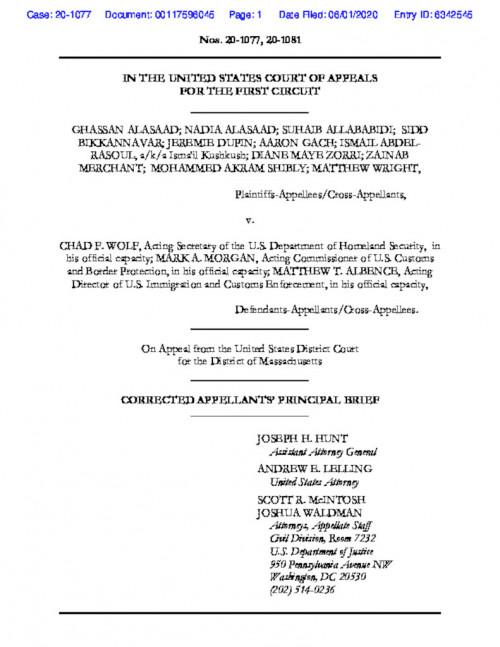
Alasaad v. Wolf - Government's Principal Brief (1st Cir. June 1, 2020)


icon of a border agent examining digital devices Press Release  | November 12, 2019

Federal Court Rules Suspicionless Searches of Travelers Phones and Laptops Unconstitutional


BOSTONIn a major victory for privacy rights at the border, a federal court in Boston ruled today that suspicionless searches of travelers electronic devices by federal agents at airports and other U.S. ports of entry are unconstitutional. The ruling came in a lawsuit, Alasaad v. McAleenan, filed by...


Document  | August 27, 2019

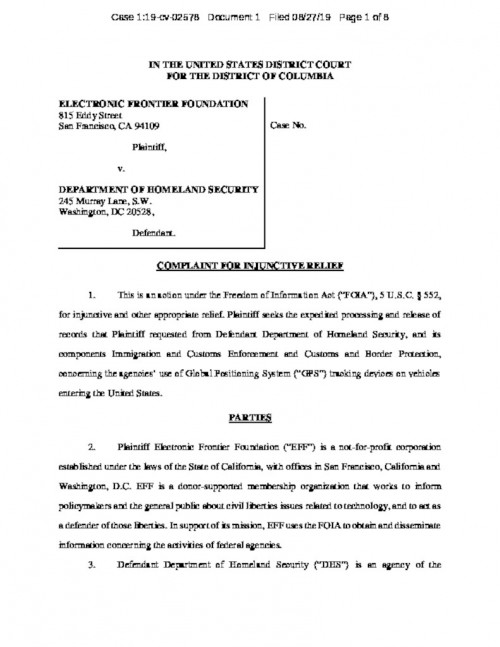
EFF v. DHS FOIA Complaint (GPS tracking)


Biometrics HART Deeplinks Blog byJason Kelley  | May 8, 2019

Shareholders Demand To Know How Northrop Grumman Will Protect Human Rights While Building Massive DHS Database


Over the next few years, the Department of Homeland Security (DHS) plans to implement an enormous biometric collection program which will endanger the rights of citizens and foreigners alike. The agency intends to collect at least seven types of biometric identifiers, including face and voice data, DNA, scars, and tattoos,...


Security Education Deeplinks Blog byAdam Schwartz  | April 30, 2019

We Got U.S. Border Officials to Testify Under Oath. Heres What We Found Out


This is a guest post by Hugh Handeyside, Senior Staff Attorney, ACLU National Security Project, Nathan Freed Wessler, Staff Attorney, ACLU Speech, Privacy, and Technology Project, and Esha Bhandari, Staff Attorney, ACLU Speech, Privacy, and Technology Project. It was originally posted on the ACLU Speak Freely...


Pages

1

2

3

4

5

6

7

8

9


next 

last »


Back to top


EFF Home

Follow EFF:


mastodon

facebook

instagram

x

Blue Sky

youtube

flicker

linkedin

tiktok

threads


Check out our 4-star rating on Charity Navigator.
 

Contact


General

Legal

Security

Membership

Press


About


Calendar

Volunteer

Victories

History

Internships

Jobs

Staff

Diversity & Inclusion


Issues


Free Speech

Privacy

Creativity & Innovation

Transparency

International

Security


Updates


Blog

Press Releases

Events

Legal Cases

Whitepapers

EFFector Newsletter


Press


Press Contact


Donate


Join or Renew Membership Online

One-Time Donation Online

Giving Societies

Corporate Giving and Sponsorship

Shop

Other Ways to Give


Copyright (CC BY)

Trademark

Privacy Policy

Thanks


JavaScript license information