Skip to content
Home
News
Sport
Business
Technology
Health
Culture
Arts
Travel
Earth
Audio
Video
Live
●Home
●News
●US & Canada
●UK
●UK Politics
●England
●N. Ireland
●N. Ireland Politics
●Scotland
●Scotland Politics
●Wales
●Wales Politics
●Africa
●Asia
●China
●India
●Australia
●Europe
●Latin America
●Middle East
●In Pictures
●BBC InDepth
●BBC Verify
●Sport
●Business
●World of Business
●Technology of Business
●NYSE Opening Bell
●Technology
●Artificial Intelligence
●AI v the Mind
●Health
●Culture
●Film &TV
●Music
●Art & Design
●Style
●Books
●Entertainment News
●Arts
●Arts in Motion
●Travel
●Destinations
●Africa
●Antarctica
●Asia
●Australia and Pacific
●Caribbean & Bermuda
●Central America
●Europe
●Middle East
●North America
●South America
●World’s Table
●Culture & Experiences
●Adventures
●The SpeciaList
●Earth
●Science
●Natural Wonders
●Climate Solutions
●Sustainable Business
●Green Living
●Audio
●Podcast Categories
●Radio
●Audio FAQs
●Video
●BBC Maestro
●Discover the World
●Live
●Live News
●Live Sport
Darling: 'Alarm bells ringing' for UK economy
Alistair Darling warns regulators to "stay vigilant" on Today
Regulators must remain "very very" vigilant about the risks to the economy, former chancellor Lord Darling has told the BBC - 10 years on from the start of the financial crisis.
He said a rising level of consumer debt in the economy was a growing concern.
Lord Darling was speaking on the 10th anniversary of the 2007 crash, which led to the government spending billions of pounds rescuing major banks.
He said the financial system was now safer but warned of "complacency".
"The lesson from 10 years ago is that something that can start as apparently a small ripple in the water can become mountainous seas very quickly," he told BBC Radio 4's Today programme.
The Labour peer said that over the last seven or eight years the economy had grown with "the odd stutter".

 Getty Images
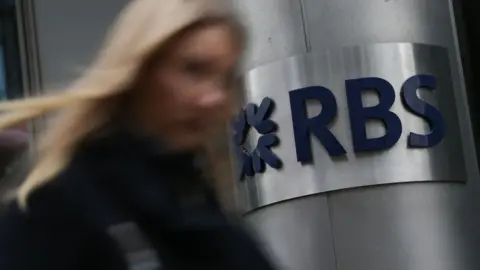
RBS was 'haemorrhaging money' and close to total collapse, said Mr Darling
However, he said he was concerned it was now starting to slow down again and that Brexit was causing "massive uncertainty".
This, coupled with rising levels of consumer debt, should "raise alarm bells" for an economy so dependent on consumer spending, he said.
"When interest rates go up, and they will go up, if not this year then certainly next year, and suddenly people find they are going to be paying more in their monthly payments, that's when you need to watch out."
War stories
Lord Darling - or Alistair Darling as he was then known - became chancellor of the exchequer in June 2007, two months before French bank BNP Paribas famously shut down several investment funds citing problems in the US securities market.
This is widely viewed as the start of the financial crisis, and the former chancellor recalled: "As in every other treasury in the world, problems in the financial industry simply had not surfaced."
 Getty Images
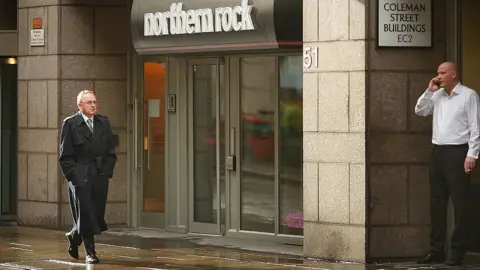
The government was forced to nationalise Northern Rock
Over the next few years the government was forced to step in as global financial markets seized up and banks stopped lending to each other.
It nationalised some lenders and provided tens of billions of taxpayers' money to prop up banks such as RBS that otherwise would have collapsed.

Analysis: Simon Jack, business editor
The collapse of US investment bank Lehman Brothers saw workers take home their careers in boxes.
Then there was the first run on a UK lender in 140 years, and the massive bailout of a British bank that had become the biggest in the world.
It all started 10 years ago when a French bank admitted it didn't know what its investments in US property were worth - if anything.
That BNP Paribas press release became a panic that turned into paranoia as trust between financial institutions evaporated.
On 9 August 2007 we felt the first tremor of a full-blown financial earthquake, whose aftershocks we are still dealing with today - nationally, locally and personally.
The crisis: 10 years in three charts
Lew: Financial risks 'still substantial'
Rogoff: China no longer biggest threat
 "In the early stages it looked that there was just a problem with [the bank] Northern Rock," Lord Darling said.
"However, it became clear as we went through August of 2007 that more and more banks were becoming reluctant to lend to each other - which was extraordinary at that time - and that there was a more deep-seated problem."
'Haemorrhaging money'
"Probably the most scary moment" of the crisis, he said, was the run on RBS by its corporate customers in October 2008.
"I had to go to one of these meetings of European finance ministers, and I was asked to come out and take a call from the then chairman of RBS [Tom McKillop] who said the bank was haemorrhaging money," Mr Darling said.
"Remember this was not only the biggest bank in the world, it was about the same size as the entire UK economy.
"I said to him, how long can you last? And what he said to me shook me to the core. He said, 'well we're going to run out of money in the early afternoon'."
'Risk of complacency'
If the government hadn't intervened quickly, Lord Darling said, "there would have been blind panic throughout the entire banking system, not just in the UK but around the world".
He said banks today were much better capitalised than in 2007 and regulators "more sharp and ready to intervene".
But he warned the next crisis was likely to come from "somewhere unexpected and from causes that haven't yet been identified".
"The biggest danger is complacency. And of course in a few years' time when institutional memories start to fade, and the people around have all gone and retired, then that's where the risk occurs."
 Get news from the BBC in your inbox, each weekday morning

Lew: Financial risks 'still substantial'
The crisis: 10 years in three charts
The great crash - 10 years on
US regulator mulls banking rule reform
RBS returns to profit in first half of year
Rate rises 'may be more than expected'
Home
News
Sport
Business
Technology
Health
Culture
Arts
Travel
Earth
Audio
Video
Live
Weather
BBC Shop
BritBox
The BBC is in multiple languages
Read the BBC In your own language
Oduu Afaan Oromootiin
Amharic ዜና በአማርኛ
Arabic عربي
Azeri AZƏRBAYCAN
Bangla বাংলা
Burmese မြန်မာ
Chinese 中文网
Dari دری
French AFRIQUE
Hausa HAUSA
Hindi हिन्दी
Gaelic NAIDHEACHDAN
Gujarati ગુજરાતીમાં સમાચાર
Igbo AKỤKỌ N’IGBO
Indonesian INDONESIA
Japanese 日本語
Kinyarwanda GAHUZA
Kirundi KIRUNDI
Korean 한국어
Kyrgyz Кыргыз
Marathi मराठी
Nepali नेपाली
Noticias para hispanoparlantes
Pashto پښتو
Persian فارسی
Pidgin
Polish PO POLSKU
Portuguese BRASIL
Punjabi ਪੰਜਾਬੀ ਖ਼ਬਰਾਂ
Russian НА РУССКОМ
Serbian NA SRPSKOM
Sinhala සිංහල
Somali SOMALI
Swahili HABARI KWA KISWAHILI
Tamil தமிழில் செய்திகள்
Telugu తెలుగు వార్తలు
Thai ข่าวภาษาไทย
Tigrinya ዜና ብትግርኛ
Turkish TÜRKÇE
Ukrainian УКРАЇНСЬКA
Urdu اردو
Uzbek O'ZBEK
Vietnamese TIẾNG VIỆT
Welsh NEWYDDION
Yoruba ÌRÒYÌN NÍ YORÙBÁ
Follow BBC on:
Terms of Use
Subscription Terms
About the BBC
Privacy Policy
Cookies
Accessibility Help
Contact the BBC
Advertise with us
Do not share or sell my info
BBC.com Help & FAQs
Content Index
Set Preferred Source
Copyright 2026 BBC. All rights reserved. The BBC is not responsible for the content of external sites. Read about our approach to external linking.